Header Image

Header Image
Showing posts with label Becky's Book Reviews. Show all posts

Monday, June 29, 2009

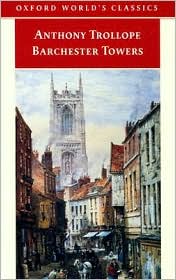
Barchester Towers


Trollope, Anthony. 1857. Barchester Towers. 528 pages.

In the latter days of July in the year 185--, a most important question was for ten days hourly asked in the cathedral city of Barchester, and answered every hour in various ways. Who was to be the new Bishop?

Barchester Towers is the second novel in Trollope's Barset series. The first in the series, The Warden, I reviewed several months ago. What characters carry over to the second one? Mr. Harding, the former warden, and his two daughters: Susan, married to Dr. Grantly, the archdeacon, the son of the very recently deceased Bishop, and Eleanor Bold, a (somewhat-recent) widow and the mother of young Johnny Bold.

Barchester Towers is about how complicated and convoluted relationships can become. It's not just about church politics. It's about social relationships as well. Though church politics does capture much of it. Who will be the new Bishop? Who will be the new warden of Hiram's Hospital? Who will be the new Dean?
The novel is a romantic comedy of sorts. Eleanor, a widow, is quite the catch and there are plenty of men in the neighborhood who would do almost anything to win her heart. But not all of them are worthy of it. And some of them are more interested in her money than in her. Her three suitors are Mr. Obadiah Slope (boo, hiss if you like, trust me he deserves it!), Mr. Bertie Stanhope, and Mr. Francis Arabin. Two of the three are church men. Mr. Slope is chaplain and in the employ of the new bishop, Mr. Proudie. And Mr. Arabin is the vicar of St. Ewold. Mr. Stanhope is a gambler mostly, an idle man who thinks only of living in the moment. Does Eleanor want to be courted? Is she looking for a second husband? A step-father for young Johnny? Whether or not this is the case, it can't be denied that the men in the neighborhood are looking at her.

I said Barchester Towers is a comedy, and that is very much the case. Comical characters abound in Barchester Towers! Mr. Slope. Dr. Proudie. Mrs. Proudie. Those three can get into so much trouble all on their own! I feel a bit sorry for Mr. and Mrs. Quiverful and their fourteen (living) children, a family that gets caught in this tug-of-war power play. Will he or won't he be named the new warden? And those are just a handful of the characters we meet in this second novel. There are the Stanhopes (including the married and attention-grabbing Madame Neroni), the Thornes, and the lower-class sort including the Lookalofts and the Greenacres. I believe Miss Thorne's party is the delight of the novel--spanning about eight chapters.

The order of the day was to be as follows. The quality, as the upper classes in rural districts are designated by the lower with so much true discrimination, were to eat a breakfast, and the non-quality were to eat a dinner. Two marquees had been erected for these two banquets: that for the quality on the esoteric or garden side of a certain deep ha-ha; and that for the non-quality on the exoteric or paddock side of the same. Both were of huge dimensions—that on the outer side was, one may say, on an egregious scale—but Mr. Plomacy declared that neither would be sufficient. To remedy this, an auxiliary banquet was prepared in the dining-room, and a subsidiary board was to be spread sub dio for the accommodation of the lower class of yokels on the Ullathorne property.

No one who has not had a hand in the preparation of such an affair can understand the manifold difficulties which Miss Thorne encountered in her project. Had she not been made throughout of the very finest whalebone, riveted with the best Yorkshire steel, she must have sunk under them. Had not Mr. Plomacy felt how much was justly expected from a man who at one time carried the destinies of Europe in his boot, he would have given way, and his mistress, so deserted, must have perished among her poles and canvas.

In the first place there was a dreadful line to be drawn. Who were to dispose themselves within the ha-ha, and who without? To this the unthinking will give an off-hand answer, as they will to every ponderous question. Oh, the bishop and such-like within the ha-ha, and Farmer Greenacre and such-like without. True, my unthinking friend, but who shall define these such-likes? It is in such definitions that the whole difficulty of society consists. To seat the bishop on an arm-chair on the lawn and place Farmer Greenacre at the end of a long table in the paddock is easy enough, but where will you put Mrs. Lookaloft, whose husband, though a tenant on the estate, hunts in a red coat, whose daughters go to a fashionable seminary in Barchester, who calls her farm-house Rosebank, and who has a pianoforte in her drawing-room? The Misses Lookaloft, as they call themselves, won't sit contented among the bumpkins. Mrs. Lookaloft won't squeeze her fine clothes on a bench and talk familiarly about cream and ducklings to good Mrs. Greenacre. And yet Mrs. Lookaloft is no fit companion and never has been the associate of the Thornes and the Grantlys. And if Mrs. Lookaloft be admitted within the sanctum of fashionable life, if she be allowed with her three daughters to leap the ha-ha, why not the wives and daughters of other families also? Mrs. Greenacre is at present well contented with the paddock, but she might cease to be so if she saw Mrs. Lookaloft on the lawn. And thus poor Miss Thorne had a hard time of it.

And how was she to divide her guests between the marquee and the parlour? She had a countess coming, an Honourable John and an Honourable George, and a whole bevy of Ladies Amelia, Rosina, Margaretta, &c; she had a leash of baronets with their baronnettes; and, as we all know, she had a bishop. If she put them on the lawn, no one would go into the parlour; if she put them into the parlour, no one would go into the tent. She thought of keeping the old people in the house and leaving the lawn to the lovers. She might as well have seated herself at once in a hornet's nest.
Anthony Trollope is fast-becoming one of my favorite authors. I am just falling in love with him. His style, his wit, his humor, his characterizations. The way he can talk about anything (and everything) and make me care. Even the bad guys. Trollope develops these scummy characters with such grace and charm that even though you know they're no good, you enjoy spending time with them.


© Becky Laney of Becky's Book Reviews

Wednesday, June 17, 2009

Becky Reviews Middlemarch

Eliot, George. 1871/1872. Middlemarch. 791 pages.
Miss Brooke had that kind of beauty which seems to be thrown into relief by poor dress.
Who is George Eliot? Mary Ann Evans, a woman writer in the nineteenth century who published many novels including Middlemarch, Silas Marner, Adam Bede, and A Mill on the Floss. Middlemarch is a long novel, quite a chunkster, and it does require commitment from the reader. It's a complex novel with many characters and many story lines. There isn't necessarily one story line that outshines all the others. I think how readers explain what it's all about has more to do with them than with the book in a way. If you're looking for a romance, you'll find the makings of it in Middlemarch, but it is so much more than a romance. If you're looking only for romance, you'll probably find it a bit boring. It addresses the complexities of the time in which it is set--the 1830s--we've got politics, economics, and society--especially society. To sum it up, Middlemarch is a novel about characters who have made really foolish choices and are having to learn to deal with them. Some adapt and change with grace and dignity. Others don't. Other's won't. Some let the weight of their mistakes drag them down. Of course, that doesn't quite describe all the book or all the characters.
Dorothea Brooke makes a big mistake in marrying a much older man, an incompetent scholar, Edward Casaubon, who transforms into a cruel, controlling, jealous man.
Fred Vincy makes a big mistake when he can't pay his debts. He convinces Caleb Garth, the father of the woman he loves, Mary Garth, to agree to pay his debts if and only he can't come up with the funds. Of course, his intentions are that the Garths won't be stuck paying off his debts. But well, you know what they say about good intentions...
Tertius Lydgate makes a big mistake when he marries Rosamond Vincy, a vain, shallow woman who's selfish to the core. I don't know if her selfishness can compete with let's say Scarlett O'Hara, but she's a horrible wife for this doctor!
Will Ladislaw makes a big mistake when he falls in love with Dorothea (she's married to his cousin)...and yet because he can't have the woman he loves...decides to fall into a flirtatious affair with Rosamond Vincy (another married woman).
And then there is poor old Nicholas Bulstrode. But that's a whole other story.
My good friend, Anonymous L, asks, "What did you think about the last lines of Middlemarch?"
I liked the bit about "the growing good of the world is partly dependent on unhistoric acts; and that things are not so ill with you and me as they might have been, is half owing to the number who lived faithfully a hidden life, and rest in unvisited tombs." I think it is very true.
Sandra asks, "Did you enjoy it? Is Middlemarch worth my time or is it just another book about women and romance?"
Yes and no. Don't let the 'and no' scare off potential readers. I thought the text bogged down here and there. It's hard for all readers to find all story lines of equal interest. And there were some chapters that bogged down (for me) in politics. Some characters had back stories that were complex and detailed. And not every chapter furthered the plot, in my opinion. That being said, there were moments where it was pure fun to be reading this book. Some of the best characters, in my opinion, were the minor characters. I liked Mrs. Cadwallader, Celia Brooke, and all of the Garths. And I rather liked Mr. Farebrother.
This isn't strictly speaking a romance though people do fall in love. It's more about what comes after. What happens after the wooing is over. What happens when the people you profess you love, disappoint you. What happens when you're sick and tired of being married and tied down.
It's a novel about expectations (ideals) and reality. And how reality has a way of slapping you in the face.
It's a novel that focuses just as much on men as it does in women.
Rebecca asks, "Is it worth the time and energy? What kinds of readers would be most likely to enjoy it?"
I think it depends on your timing. I think this one can be absorbing and draw readers in. And I think it can be intimidating in parts as well. I'm glad I read it. I liked parts of it. But I didn't like every part of it. I think patient readers will enjoy it. I think folks who are more into character-focused novels will enjoy it. It's a slower-paced novel. I think folks who already have an interest in classics would be more likely to enjoy it.
Eva asks, "Do you enjoy that device [of authors making interjections and asides to the reader] in novels...or does it snap you out of the narrative?"
I like it in certain novels. I think it can add a lot to some books. I didn't notice it as much in Eliot as I have in other novels I've been reading lately. (Though many of the lines I underlined were like this.) But I am love, love, loving it in my Anthony Trollope novels!
Jodie asks, "Is Middlemarch the first book by Eliot that you have read? How were the female characters in the book portrayed?"
I've also read and reviewed Silas Marner. I hope to read more of Eliot in the upcoming years. As for how female characters were portrayed, I think there were diverse representations: all classes of women (lower, middle, upper). I hate to use the word 'types' but for lack of a better one...there were maternal types, pure-and-true-and-faithful types, understanding stand-by-my-man types, gossip-loving types, romantic and idealistic types, mean and spiteful types, shallow, vain, and selfish types. Some of the women characters were intelligent conversationalists, and others were more in the shadows of their husbands. Some women wanted to wear the pants in the family, others not so much. No doubt they'll be some characters you dislike. But you'll probably find some characters to like as well.
© Becky Laney of Becky's Book Reviews

Wednesday, May 13, 2009

Wuthering Heights


Bronte, Emily. 1847. Wuthering Heights.

In my effort to give books a second chance, I finished Emily Bronte's Wuthering Heights over the weekend. My question was this, would I love it--or like it even--if I weren't being required to read it. If I could divorce my memories associated with the novel from English class. (Now, before I get jumped on in the comments, I'm not complaining about literature classes. I spent roughly six years studying literature.) But. I have to be honest. I'm still not that thrilled with Wuthering Heights. Heathcliff doesn't make my heart go pitter-pat. (I'd question my mental health if it did). Heathcliff and Catherine? More than a little annoying. I'd be hard-pressed to find a character that I feel sympathetic towards.

The story--in case you don't know--is about a hopeless love affair between two grouchy people. Perhaps grouchy isn't quite the word. Both are tempermental. Both are stubborn. Both are prone to melodrama. Both are selfish. One is more diabolically evil than the other. But neither one is likeable. Heathcliff and Catherine. The novel is about love and hate, revenge, bitterness, cruelty, heartache, greed, power, ambition, and above all manipulation.

I will grant the book this, I didn't fall asleep this go round. One thing that I think really and truly helped me out this time was Bella and Edward. Don't laugh. It was Eclipse where Bella oh-so-dramatically quoted on and on about Wuthering Heights and how the very fact that these two loved each other redeemed everything; it made two unsympathetic people be sympathetic. (The two wrongs make a right philosophy, I suppose.)

I can't believe you're reading Wuthering Heights again. Don't you know it by heart yet?

Not all of us have photographic memories, I said curtly.

Photographic memory or not, I don't understand why you like it. The characters are ghastly people who ruin each others' lives. I don't know how Heathcliff and Cathy ended up being ranked with couples like Romeo and Juliet or Elizabeth Bennet and Mr. Darcy. it isn't a love story, it's a hate story.

You have some serious issues with the classics, I snapped.

Perhaps it's because I'm not impressed by antiquity. He smiled, evidently satisfied that he'd distracted me. Honestly though why do you read it over and over? His eyes were vivid with real interest now, trying --again-- to unravel the convoluted workings of my mind. He reached across the table to cradle my face in his hand. What is it that appeals to you?

His sincere curiosity disarmed me. I'm not sure, I said, scrambling for coherency while his gaze unintentionally scattered my thoughts I think it's something about the inevitability. How nothing can keep them apart -- not her selfishness, or his evil, or even death, in the end...

His face was thoughtful as he considered my words. After a moment he smiled a teasing smile I still think it would be a better story if either of them had one redeeming quality.

I think that may be the point, I disagreed. Their love is their only redeeming quality.


p. 28
The way Catherine spoke about Heathcliff, about love, her tendency to be so melodramatic reminded me so much of Bella. (True, Edward is a better hero than Heathcliff in that he isn't evil incarnate.)

My mind also kept jumping back to Frankenstein and trying to find comparisons between the two. I'm not sure what that was about. Perhaps it was the framework of the story, perhaps it was the harshness of some of the environments, perhaps it was the hopelessness of it all. But while Frankenstein had a soul to it, Wuthering Heights, I felt lacked it.


© Becky Laney of Becky's Book Reviews

The Warden


Trollope, Anthony. 1855. The Warden. Oxford World's Classics. 294 pages.

The Rev. Septimus Harding was, a few years since, a beneficed clergyman residing in the cathedral town of -----; let us call it Barchester.

This is a charming little classic concerning ethics. While that, strictly speaking, is true, it's not really the half of it. It's about one man, Mr. Harding, and his family: two daughters, one married, the other quite single. It's also about Harding's neighborhood and circle of friends. It's about the necessity of having a good reputation and a clean conscience.

Eleanor is the apple of her daddy's eye. Susan is married to an Archdeacon. (I *believe* his name is Grantley). Because of his eldest daughters good fortune in marriage, Mr. Harding, has been named warden of Hiram's Hospital (alms house). The 'enemy' of Mr. Harding (and the suitor of Eleanor) is a young man named John Bold. When we are first introduced to these characters, we are learning that Bold is encouraging a law suit against Mr. Harding. He feels that Mr. Harding is in violation of the will. (Way, way, way back when (several centuries past), a man left his (quite wealthy) estate to the church. The church followed the will for the most part, but as times changed, they changed the way they carried it out. They were following it through in spirit in a way: still seeking to take care of twelve poor men (bedesman) but over time the salary of the warden increased.) Bold has stirred up the twelve bedesmen into signing a petition demanding justice, demanding more money, demanding 'fairer' distribution of funds.

The book presents this case through multiple perspectives: through two Grantleys (father and son), a few lawyers, Mr. Harding and Mr. Bold, of course, and through a handful of the twelve men involved that would profit from the change. There is one man whose voice seems louder than all the rest. And that voice comes from the newspaper, the Jupiter, one journalist writes harsh, condemning words directed at Mr. Harding--he assumes much having never met Harding personally. These words weigh heavy on the heart and soul of Mr. Harding. (And they don't sit easy on Mr. Bold either.)

Can Mr. Harding get his reputation back? What is the right thing to do? Is he in violation of the will? Is the church? What is his moral responsibility in caring for these twelve poor-and-retired men? What is his responsibility to the community?

The Warden is a charming little book. In part because of the language and style. There's an easiness and rightness about it. It was one of those cases where I knew almost from the start that Trollope and I would come to be good friends. Though I'd never read any Trollope before, never seen a movie based on one of his books, reading Trollope felt like coming home. Trollope was good at characterization and equally good at storytelling.

© Becky Laney of Becky's Book Reviews

Saturday, March 14, 2009

The Morgesons


Stoddard, Elizabeth. 1862. The Morgesons. 264 pages.

"That child," said my aunt Mercy, looking at me with indigo-colored eyes, "is possessed."

Have you heard of Elizabeth Stoddard? I hadn't either. Not until I stumbled across this book while looking for Steinbeck. In the introduction, it explains a bit why this author fell into obscurity although during her lifetime she was compared with such greats as Balzac, Tolstoy, Eliot, the Brontes, and Hawthorne. (If your library doesn't have a copy, you can read it online here.)

Is it an exciting read? a thrilling one? Not really. Not by today's standards. It's about one girl, Cassandra "Cassy" growing up, coming to age. We follow her roughly from the age of ten to twenty. We see her in various environments and situations--home, visiting relatives for extended periods of time, school, courting, etc. She's not an easy narrator to love. She's more abrasive than that. There seems to be friction, tension, strife in almost all of her relationships. Perhaps because her whole family is 'difficult' to get along with. Perhaps because she's stubborn and makes no apologies. She's not meek or mild.

As a reader, I was never sure of Cassy. If she was the one disconnecting from her family...or if maybe her family were the ones disconnecting from her. There never seemed to be a bond between family members. Not with her mother. Not with her sister. And only slightly with her father. And this slight bond is only because he allows his daughter to go off on all these adventures away from home to visit family and friends, etc. He also keeps her well dressed. So I never was sure if she genuinely loved her father. Or if she just seemed to like him best because he was the one who was able to grant her desires. There seems to be a harsh distance, an emotional barrier that prevents Cassy from genuinely loving and being loved. As I said, I'm not sure who is to blame for this.

Cassy seems to attract some strange men to her. Especially true in the case of her cousin, Charles. Though married, though a father, he seems to find Cassandra irresistible. And though it is never out and out revealed, this attraction is mutual. Cassy, still a teen, maybe fifteen or sixteen?, finds herself in love with her cousin, inappropriate as it may be. See, she's come to live with her cousin and his wife, Alice. She's with this seemingly 'happy' family for a little over a year. And his wife, Alice, is aware that there is something going on between the two. But she's so busy being a good and perfect wife and mother that she pretends she doesn't know or doesn't care. What strikes me is one scene where Charles returns home from a business trip, I believe, and gives Cassandra a diamond ring to wear on her third finger. I don't remember if "good" little Alice gets a present as well, and if so, what it might have been. But there's a distinctly creepy vibe from this family.

Other men in Cassy's life are a pair of brothers, Ben and Desmond Somers. Both alcoholics. (They come from one crazy family!) One marries Cassandra. One marries Cassandra's sister, Veronica. Only one sister will get her happily ever after ending. But which one? Can a 'bad' boy ever turn good and mean it?

Though Cassandra seems a bit of an unnatural heroine, I am glad to have read this one. (After all, Scarlett O'Hara is plenty unnatural!)

Friday, March 13, 2009

Silas Marner


Eliot, George. 1861. Silas Marner. Bantam Classics. (My edition was mid 1980s) 186 pages.

In the days when the spinning-wheels hummed busily in the farmhouses--and even great ladies, clothed in silk and thread-lace, had their toy spinning-wheels of polished oak--there might be seen, in districts far away among the lanes, or deep in the bosom of hills, certain pallid undersized men, who, by the side of the brawny country folk, looked like the remnants of a disinherited race.


Shocker of all shockers: I liked this one. Quite a lot, in fact. Why is that shocking? When I read this little volume--and no, it's not the same copy--in tenth grade I absolutely hated it. Hate is really too kind a word for what I felt. Needless to say, it held the title of most-hated-book until my college days when Jude the Obscure took its place. (It still holds the honor, in case you're curious.) Which just goes to show you that almost without a doubt classics--at least some classics--fail to be appreciated by high schoolers. Maybe that's inaccurate. I'll rephrase, anytime a person--especially a teen person--is required to read a book, no matter how good or great that book is (sometimes they're really bad, I'm not saying all are good) then it's an uphill battle to have him/her have a positive response to it. It just goes against human nature to like something we're forced against our will to read. And its understandable to me. What could a fifteen year old have in common with Silas Marner, a middle-aged weaver obsessed with gold? He's old (relatively speaking at least!). He's strange. No one likes him in his village of Raveloe. He's an outsider, it's true, a loner. And arguably some teens could see themselves in that way. But is that enough?

Silas Marner, in case you've never been subjected to it, is the story of a man, a weaver, who takes refuge in Raveloe after escaping his unfortunate past. He is living only for himself. The money he makes from his trade, he hoards. He loves his gold. Treasures it. He's not the only one keeping secrets in the village. There's a man, Godfrey Cass, who has quite a secret. Something in his past that he's willing to do just about anything, pay just about anything to prevent from coming to light. His brother, Dunstan Cass, is blackmailing him. He'll tell all to their father--Squire Cass--if Godfrey doesn't do things his way. Why does Godfrey care? really really care? He wants to marry Nancy Lammeter. The secret? He already has a wife, a wife his father would never approve of, a wife he's ashamed of, a woman he'd never claim in a hundred million years. Dunstan (and Godfrey) are in need of money, Silas Marner has plenty. Put the two together and you've got a robbery destined to happen. But things don't always go according to plan, Dunstan disappears the same night as Silas' gold. But that's just the beginning. Silas doesn't know it then, but things are about to start looking up! His life is about to change for the better! Why? His "gold" will be returned to him--providentially according to Silas and his friends--in the form of a golden-haired baby girl whom he names Hepzibah (Eppie) whom he adopts and raises to the satisfaction of all but one....Godfrey Cass.

This one had themes that I couldn't even begin to grasp as a sophomore. And the language? the style? I didn't appreciate the little things. The phrases. But here's the thing. I can now. Everything that I missed then, I can appreciate now. Here is one of my favorite passages:

I suppose one reason why we are seldom able to comfort our neighbors with our words is, that our goodwill gets adulterated, in spite of ourselves, before it can pass our lips. We can send black puddings and pettitoes without giving them a flavour of our own egoism; but language is a stream that is almost sure to smack of a mingled soil. There was a fair proportion of kindness in Raveloe; but it was often of a beery and bungling sort, and took the shape least allied to the complimentary and hypocritical. (77)


I liked the characters--some more eccentric than others--too. I came to appreciate the flavor of this one.

  © Blogger template 'Minimalist E' by Ourblogtemplates.com 2008

Back to TOP