Header Image

Header Image

Tuesday, August 4, 2009

Crocodile on the Sandbank by Elizabeth Peters

«Amelia Peabody is Elizabeth Peters’ best loved and brilliant creation, a thoroughly Victorian feminist who takes the stuffy world of archaeology by storm with her shocking men’s pants and no-nonsense attitude!
In this first Egyptian mystery, our headstrong heroine decides to use her substantial inheritance to see the world. On her travel, she rescues a gentlewoman in distress – Evelyn Barton-Forbes – and the two become friends. The two companions continue to Egypt where they face mysteries, mummies and the redoubtable Radcliffe Emerson, an outspoken archaeologist, who doesn’t need women to help him solve mysteries – at least that’s what he thinks!»


England, Victorian Era. Amelia Peabody, a middle aged spinster and somewhat of a scholar, just inherited a considerable amount of money from her deceased father, seeing this as her opportunity for freedom, she decides to travel to Egypt and explore all the places she’s been reading about in books. Armed with her parasol and a unique personality, Amelia ventures into a world of men, who don’t take lightly to being ordered about by a woman, especially one as eccentric as her.

Meeting a stranger on the way and learning about her unfortunate story, Amelia takes Evelyn under her wing and together they explore Egypt’s monuments and sail down the Nile, constantly battling against the crew’s ideas of what a proper visit should be. When reaching Amarna’s archaeological dig, little do they know that their trip is at an end, the Emerson brothers, their recent acquaintances, are facing serious problems, Radcliffe has been struck down by illness and the workers are becoming superstitious. Not one to flee in the face of adversity, Amelia sets to saving Racliffe’s life while taking over the excavation, that is, until he recovers and tries to put her in her place. They both seem to have found their match!

This cosy mystery is the start of a series that I have the feeling will fast become one of my favourites, Amelia Peabody is almost like a female Indiana Jones, she’s witty, smart and isn’t afraid of anything, plus she’s a threat to anyone with her parasol. Radcliffe Emerson is the perfect hero, handsome, dark sense of humour, strong and sure of himself with just the right touch of arrogance. The mystery revolves around the appearance of a mummy and its apparent interest in Evelyn, but the gist of the story is Amelia and Emerson’s relationship, we soon clue in to the culprit and his reasons, but we still enjoy ourselves due to their fights and constant banter.

Despite this first volume having been published in 1975, the story and tone are still up to date, Elizabeth Peters has managed to create a timeless series that will surely continue to win fans for years to come. I for one am reading the second volume and am thrilled there are still 16 to go and one in the works. :-)

Rating: 5/5

Review also published here.

Friday, July 24, 2009

And Only to Deceive by Tasha Alexander

«For Emily, accepting the proposal of Philip, the Viscount Ashton, was an easy way to escape her overbearing mother, who was set on a grand society match. So when Emily’s dashing husband died on safari soon after their wedding, she felt little grief. After all, she barely knew him. Now, nearly two years later, she discovers that Philip was a far different man from the one she had married so cavalierly. His journals reveal him to have been a gentleman scholar and antiquities collector who, to her surprise, was deeply in love with his wife. Emily becomes fascinated with this new image of her dead husband and she immerses herself in all things ancient and begins to study Greek.
Emily’s intellectual pursuits and her desire to learn more about Philip take her to the quiet corridors of the British Museum, one of her husband’s favorite places. There, amid priceless ancient statues, she uncovers a dark, dangerous secret involving stolen artifacts from the Greco-Roman galleries. And to complicate matters, she’s juggling two very prominent and wealthy suitors, one of whose intentions may go beyond the marrying kind. As she sets out to solve the crime, her search leads to more surprises about Philip and causes her to question the role in Victorian society to which she, as a woman, is relegated.»


England, Victorian Era. Lady Emily Ashton, newly wed, has just lost her husband to a raging fever while he was on an African safari with a couple of friends. Having married him to escape her mother’s rule, she’s not as grief stricken as she should be, Philip was a stranger to her and she almost feels relief at his departure. But oddly, after a while, through his friends and acquaintances, the books he liked to read and the antiquities he collected, Emily perceives a side of her husband she didn’t know existed and as shocking as it is, he seemed to actually be in love with her.

Seduced by this unknown facet of the man she married, Lady Emily starts to take interest in the same things he did and slowly falls in love with him, finally feeling the grief of his loss. But as she digs through the past she uncovers facts that were better left untouched, not everything is as it seems and maybe Philip wasn’t such an honest and trustworthy man after all. Who was the real Philip and what actually happened to him in Africa?

We accompany Lady Emily in the pursuit for the truth and can’t help but fall in love with her, we watch her grow as a person and especially as an independent woman who isn’t afraid to stray from the norm and start studying Greek and drinking Port instead of Sherry like every other respectable lady. She makes new friends, such as Cecile du Lac, a French widow who collects husbands, Lady Margaret, an independent American who prefers books to suitors and Colin Hargreaves, her deceased husband’s best friend who is our dashing hero. I felt that Emily changed and grew throughout the book and in my eyes became real and believable, as opposed to Lady Julia Grey, Deanna Raybourn’s heroine, who always stays the same and doesn’t seem to learn anything in Silent in the Grave.

Although there’s a mystery to be solved here, its resolution is somewhat predictable, but it doesn’t spoil our enjoyment of the story, our focus is always on Emily and her life, the mystery is just an added bonus. I do have one complaint regarding this book though, we don’t get to see as much of Colin Hargreaves as I’d like, the author seems to tease us with his quick scenes and leaves us wanting more. Not fair! :-P

So, if you like cosy historical mysteries with a touch of humour and romance, then this is the right series for you, don’t hesitate to pick up And Only to Deceive, I’m sure you won’t be disappointed!

Rating: 4/5

Review also published here.

Tuesday, July 21, 2009

My Challenge Wrap-Up

I keep forgetting to post this on here. Sorry for the lateness. Anyway, I went for A Drink at Whitechapel and these were the books I read for the challenge, with links to my reviews.

  1. A Tale of Two Cities – Charles Dickens (06.24.09)
  2. North & South – Elizabeth Gaskell (06.30.09)
  3. Wuthering Heights – Emily Bronte (02.01.09)
I'm quite glad I only went for three books. It's not easy reading classics :)

Sunday, July 12, 2009

The Curse of the Pharaohs by Elizabeth Peters


When Lady Baskerville's husband Sir Henry dies after discovering what may have been an undisturbed royal tomb in Luxor, she appeals to eminent archaeologist Radcliffe Emerson and his wife Amelia to take over the excavation. Amid rumors of a curse haunting all those involved with the dig, the intrepid couple proceeds to Egypt, where they begin to suspect that Sir Henry did not die a natural death, and they are confident that the accidents that plague the dig are caused by a sinister human element, not a pharaoh’s curse.

Since I read A Crocodile in the Sandbank, I became a big fan of Amelia Peabody. She’s unlike any other sleuth heroine I ever read about before. Amelia is one of a kind!

The second book, The Curse of the Pharaohs starts 4 years later after the end of the 1st book. Amelia and Emerson are quietly living in Kent with their son William, nicknamed Ramses. After his birth, his parents felt they couldn’t continue their career as Egyptologists until he had grown and could accompany them to Egypt.

While they are trying not to get bored with their smooth English life, they follow in the newspapers the story of Lord Baskerville and how he possibly died of a curse after digging some pharaoh’s tomb. They are immediately interested and both surprised when Baskerville’s widow pay them a visit and asks Emerson to finish the work of her husband. If he refuses, not wanting to leave his wife and son in England, Peabody, knowing how excited he is for a new adventure, convinces him it’s for the best if he accepts the mission. In no time, they are both ready to leave for Egypt.

When they arrive, they are faced with many problems and treats that make their work even more difficult and feed even more the rumors of an ancient curse. Tired of this situation, the Emersons finally decide to get involved in this investigation and find the responsible behind the mystery.

The second book of this series is as delicious as the first one. Amelia Peabody continues to exude intelligence and sharp humor. Her reflections about her son are hilarious! The child is a little genius and develops very quickly to the amazement of both his parents. Peters does an excellent job describing him and I can perfectly imagine the little boy’s “chilling and calculating look” when he tries to manipulate his parents. I get the feeling this little Ramses is going to have some extraordinary adventures!

The chemistry between Peabody and Emerson is intact. All their dialogues, conversations and disputes produce sparks. It’s like watching an extraordinary final at Roland Garros. They know each other well but they still can surprise each other.

The story is fast-paced and the descriptions of the Egypt of those times are magnificent, making you feel as you were present during the events.

Highly recommended to any reader who enjoys a good mystery and must-read to all Amelia Peabody fans.

Grade: 4.5/5
------------------------------------
And this would be my final review of the Victorian Challenge. :)

Monday, July 6, 2009

Laura's Challenge Wrap-Up

I aimed to visit Buckingham Palace by reading six books, but I only took a tour of the British Museum with five books. I forgot just how long it takes me to read a Dickens novel and assumed I would read two books in June instead of just one. Now I know not to leave too much for the last minute … or that I should aim lower and then exceed that goal!

My original list was as follows:

1. Wuthering Heights by Emily Bronte
2. What Jane Austen Ate and Charles Dickens Knew by Daniel Poole
3. Jude the Obscure by Thomas Hardy
4. Framily Parsonage by Anthony Trollope
5. Daniel Deronda by George Eliot
6. Victoria Victorious by Jean Plaidy

Alternates:
1. Sylvia's Lovers by Elizabeth Gaskell
2. The Woman in White by Wilie Collins
3. The Old Curiosity Shop by Charles Dickens
4. Little Dorrit by Charles Dickens

I actually ended up reading:
1. Wuthering Heights by Emily Bronte
2. What Jane Austen Ate and Charles Dickens Knew by Daniel Poole
3. The Victorian Home: The Grandeur and Comforts of the Victorian Era in Households Past & Present by Ellen M. Plante
4. The Woman in White by Wilie Collins (audio)
5. The Old Curiosity Shop by Charles Dickens

I didn’t exactly stick to my original list by my addition of The Victorian Home, but I really enjoyed that book. Overall I really enjoyed this challenge and hope that there will be A Victorian Challenge Part 2 so I can finish up reading the Victorian novels on my stack!

The Old Curiosity Shop by Charles Dickens

Charles Dickens was one the most popular (if not the most popular) novelist during the Victorian period. He published The Old Curiosity Shop in his weekly serial publication “Master Humphrey’s Clock” from 1840 to 1841. I have always heard the story that Dickens’ American fans storms the piers of New York City shouting to sailors arriving from England, “Is Little Nell alive” to find out the end of this story. It’s amazing to think about so much excitement for a book. (Actually I guess it sounds like the parties awaiting the arrival of the new Harry Potter novels.) I wanted to see what all of the fuss was about.

The Old Curiosity Shop is the story of a beautiful, sweet, and innocent girl named Nell and her grandfather. They live in the titled Old Curiosity Shop, but not for long. Grandfather has a gambling addiction. He wants to make money to ensure that Nell will not have a life of hardship, but instead he gambles away all of his money as well as extensive amounts of money that he has borrowed from the shady “dwarf,” Daniel Quilp. After losing it all, Little Nell and her Grandfather wander through England. The book is the story of their journey as well as of cast of other characters left in London such as Kip, their servant; Sampson and Sally Brass (Quilp’s lawyer and his sister); Richard Swiveller (Little Nell’s brother’s friend), and others.

I loved Dickens’ detailed characters. They were all so interesting – especially to see that the way people have not really changed over time. Gambling addiction is not a new problem. I do have a problem with his female characters, they seem rather one dimensional. Sally Brass is a smart woman that works at law with her brother; therefore she is a subject of ridicule. Little Nell is a bit “too perfect.” I didn’t love her as much as I think Dickens’ meant the reader too.

The treatment of servants in the book was also interesting. The “Marchioness” doesn’t have a name and lives locked in the Brass’ basement. She is hardly given any food and somehow exists like this. I found this more than a little disturbing!!!’’

I read a book-of-the-month club edition. It has the original illustrations, which I really enjoyed looking at while I read. I also loved the description on the right-hand page on top of the current action, such as “Bank-note gone.” One wonders if you can get a quick summary of the book by only reading the headers!

SPOILER ALERT. I did not like the entire ending chapter of Little Nell’s death. It was (dare I say it?) rather sappy actually. It would have been more striking to not go on and on and on about it and her angel spirit floating away and such. Also her death didn’t really seem to serve the story that well. She hadn’t been mentioned for 100 pages or so, while we were with Kit and the others in London.

Overall, I liked the book, its world, characters, and descriptions a lot. But I don’t think I would have been waiting at the pier to find out what happened to Little Nell. This was a good Dickens novel, but not as good as my favorites (David Copperfield and A Tale of Two Cities).

Sunday, July 5, 2009

Laurie's Challenge Wrap-Up

It's official! I completed the Victorian Challenge! I read four books, two written during the Victorian period, one during the Edwardian period, and one in the 1940s. My final list was:

Charlotte Yonge, The Clever Woman of the Family
Flora Thompson, Lark Rise to Candleford
Charles Dickens, Oliver Twist
Vita Sackville-West, All Passion Spent

It was important to me that at least some of the book I read were actually written in the 19th century. Victorian literature has always daunted me, so tackling some of it at the source was a significant reason why I undertook this challenge. My favorite book of the challenge was Oliver Twist. I didn't find any of these books unpalatable, but my least favorite was likely Lark Rise to Candleford. Looking at my choices, it's perhaps a bit unfair of me to pick favorites. Oliver Twist is by most critics' assessments a work of great literature, and Lark Rise to Candleford makes no pretences to literary greatness. It's a very descriptive book, in modern parlance we might call it 'cozy.' The greatest surprise of the challenge was how easy I found it to engage Dickens. I had always been daunted by his works. This is the first I read seriously as an adult, and I found it a very rewarding experience. I will likely dig deeper into his canon. The least Victorian of these selections was All Passion Spent. I selected it based on the back cover synopsis, which suggested that the book was entirely about the Victorian period. As it turns out, it's about half and half. Overall, this has been a very rewarding challenge experience. If it happens again next year I will surely participate, and my goal will be to select and read only books written during Victoria's reign.

Thursday, July 2, 2009

Joy's Challenge Wrap-Up

I actually finished the reading for this challenge several weeks ago, but I didn't want to write a wrap-up until I had all the reviews written. Now that I've finished that task, I can say finis. I chose Level 2: A Walk in Hyde Park, which meant I read four books for the challenge. Started out with quite a list of possibilities, but as it turns out only two of the books I actually read were on that list. So, the best-laid plans and all that . . . .

Here's what I read, with links to reviews:

  1. The Age of Innocence, by Edith Wharton
  2. Angels & Insects, by A.S. Byatt
  3. The Master, by Colm Toibin
  4. The Valley of Fear, by Sir Arthur Conan Doyle
I'm also noticing that while all my books were set during the Victorian era, none was actually written then – something of a disappointment. Guess I'm just a modern girl at heart.

I enjoyed all the books, although of the four I think The Valley of Fear was one that didn't really live up to my expectations. My favorite was without a doubt The Age of Innocence – it's now on my list of all-time best reads, and it's inspired me to go back and give Wharton's House of Mirth another try, after abandoning it many years ago.

I want to thank Alex for coming up with the idea for the challenge and hosting, and all the other participants for all those great reviews and blog posts. This was a wonderful idea – I only wish I'd had time to read a little Trollope. Well, maybe next time.

[Cross-posted on my blog, Joy's Blog.]

Wednesday, July 1, 2009

Brittanie's Wrap-Up Post

I finished the Victorian Reading Challenge in the nick of time. I really enjoyed it. I did not read most of my original list. I have a TBR list of books set during this period now. Some came from reading others reviews. I did not finish Silas Marner because I was bored and it left me feeling cold so I may go back to it one day. I have not done reviews for all the books yet. I will probably do mini reviews this week. I do not have a favorite. I liked but did not love them. I look forward to a Second Victorian Reading Challenge.

Reading Levels:A drink at Whitechapel: 3 books
A walk in Hyde Park: 4 books
A tour of the British Museum: 5 books
A visit to Buckingham Palace: 6 books

I am going all the way with a visit to Buckingham Palace:6 books
1. Jane Eyre by Charlotte Bronte
2. A Tale of Two Cities by Charles Dickens or Cranford by Elizabeth Gaskell
3. Silas Marner by George Elliot or Little Women by Louisa May Alcott
4. Eight Cousins by Louisa May Alcott
5. Heidi by Johanna Spyri
6. Dracula by Bram Stoker

What I actually read:
1. And Only to Deceive by Tasha Alexander
2. Silent in the Grave by Deanna Raybourn
3. Silent in the Sanctuary by Deanna Raybourn
4. Silent on the Moor by Deanna Raybourn
5. Eight Cousins by Louisa May Alcott (reread)
6. Rose in Bloom by Louisa May Alcott (reread)
7. Heidi by Johanna Spyri

End of the challenge

I'm a day late but I wanted to officially end the Victorian Challenge. Since some people told me they were way behind with their reviews (I still have my last one to post also) but they had already read all the books they planned to, I thought we could extend the posting until the 15 July.
I wanted to thank you all for participating and sharing with all of us your reading experiences. It's was a wonderful journey!

Tuesday, June 30, 2009

All Passion Spent by Vita Sackville-West


Lady Slane spent her entire life as a politician's wife, raising six children. In the wake of her husband's death she finally has time and space to attend to her own desires. At age eighty-eight Lady Slane chooses to move to her own home, and surround herself with persons of her own choosing. And what Lady Slane chooses to do is to reminisce about her life, from her marriage in 1860 to the present day. Lady Slane's children presume that their mother has descended into madness, but she holds her ground, refusing to become the doddering widow her children expect. In this novel we learn Lady Slane's history: her thwarted dreams of becoming an artist, her love for her husband, and the restrictions incumbent on Victorian political wives. The book culminates as Lady Slane faces an awakening of unexpected passion. This is a dark and contemplative novel, though there are elements of comedy as well. The Slane children all fit into comic stereotypes, and perform their allotted roles to the point of ridiculousness. These comic elements are necessary, they allow Lady Slane to be sensible, rather than cruel, in cutting herself off from her children at the end of her life. Lady Slane's long life spans the Victorian and Edwardian periods, and if the hallmark of the Victorian era was change, than Lady Slane is certainly a good model thereof. She lived through modernization, the growth of empire, and in her reflections we see the long span of her life.


Vita Sackville-West, All Passion Spent (The Dial Press, 1984) ISBN: 0385279760


Miss Cayley's Adventures by Grant Allen

Miss Cayley

Miss Cayley's Adventures is definitely a Victorian novel. Like many works of the period it first appeared in serial form - part one was published in The Strand in March 1898.

But Lois Cayley is definitely not a typical Victorian heroine.

When her stepfather dies Miss Cayley finds herself alone in the world. The obvious thing to do would be to take her friends advice and find respectable employment as a teacher or in a hat-shop. Does she do that? No. Miss Cayley decides to step out into the world in search of adventure, grabbing whatever chances come her way.

The adventures come thick and fast, and the storytelling is quite wonderful.

Miss Cayley travels through Germany, Italy, Egypt and India. And in the course of her travels she becomes a lady's maid, a bicycle saleswoman, a house-sitter, the proprietor of a secretarial agency and a journalist. She foils a robbery, wins a cycle race and rescues an injured mountaineer.

Yes, Miss Cayley is bright, articulate, athletic and extremely resourceful. She is also engaging from the first sentence and so very likeable.

Along the way Miss Cayley makes many friends, a few enemies and she meets her true love.

It is to save him from imprisonment for a crime that she finally return to London. Does Miss Cayley save the day? Is there a happy ending? Well what do you think?!

Miss Cayley's Adventures provide wonderful entertainment from beginning to end!

Silent on the Moor by Deanna Raybourn


This is a wickedly witty Lady Julia Grey mystery. 'There are things that walk abroad on the moor that should not. But the dead do not always lie quietly, do they, lady?' It is England, 1888. Grimsgrave Manor is an unhappy house, isolated on the Yorkshire moors, silent and secretive. But secrets cannot be long kept in the face of Lady Julia Grey's incurable curiosity. In the teeth of protests from her conventional, stuffy brother, Lady Julia decides to pay a visit to the enigmatic detective, Nicholas Brisbane to bring a woman's touch to his new estate.

Grimsgrave is haunted by the ghosts of its past and its owner seems to be falling into ruin along with the house. Confronted with gypsy warnings and Brisbane's elusive behavior, Lady Julia scents a mystery. It's not long before her desire for answers leads her into danger unlike any other that she has experienced - and from which, this time, there may be no escape.


*spoiler alert*


While I really enjoyed the first two books of the Lady Julia Grey mysteries, Silent in the Moor was far from giving me the same satisfaction.

In the final pages of Silent in the Sanctuary, we learned that Lady Julia was going to visit Brisbane’s mystery house, Grimsgrave Manor, with her sister, Portia. The later was invited by the young man to help him set up a more pleasant household on his recently acquired house in Yorkshire. Of course, Brisbane isn’t aware of this sisterly plan and when he sees Julia at his doorstep, he is somehow surprised and reluctantly agrees to shelter them both.

Julia and Portia find themselves living in an old crumbling house with the almost constantly absent Brisbane and the former owners, the Allenbys: Lady Allenby and her two daughters, Ailith (the family beauty) and Hilda (the tomboy). If in the beginning they enjoy their visit, they quickly see that appearances can be very deceiving…

While I think Julia is coming out of her shell since book two and we see now how much easily she makes her own decisions and knows what she wants, I can’t stop wishing she would kick Brisbane times to times. The man is completely obnoxious! I do understand why he doesn’t want to have someone in his life, even if I find the reasons exaggerated, but after a while I stop believing he actually cares for Julia and he is, in fact, enjoying being hunted.
It’s easy to understand that while she wants to show him she cares for him, his unjustified absences and rejections would try the patience of a saint. I admired Julia to pursuit what she wanted and cheered her up when she decided it was enough.

I have to admit I was much more interested in Portia’s relationship with Jane. They are both very warm characters and this turn of events was quite a surprise since they always seemed in perfect harmony. Hopefully, Raybourn will give their relationship another go.

The atmosphere is very gloomy and sometimes made me think of Wuthering Heights even if that never really works for me.

The mystery was very predictable and, at some point, I was asking myself how they could not see what was going on. You can feel since the beginning there are many skeletons in the closet of the Allenby family, their relationship is strained and in the point of breaking… The comments and attitudes of the servants and even the family about the late Sir Redwall and then Lady Julia’s discovery of two small mummies among the family Egyptian antiquities lead us to a well known story.

Also, after the Grey sisters arrive to Grimsgrave Manor everything seems to drag and slow down. The mystery part could have been solved quickly, just as the reason of Brisbane absences.

A pleasant read recommended to the fans of the series.

Grade: 3/5

Mary Barton by Elizabeth Gaskell


This is Elizabeth Gaskell's first novel, a widely acclaimed work based on the actual murder, in 1831, of a progressive mill owner. It follows Mary Barton, daughter of a man implicated in the murder, through her adolescence, when she suffers the advances of the mill owner, and later through love and marriage. Set in Manchester, between 1837-42, it paints a powerful and moving picture of working-class life in Victorian England.


Mary Barton is Elizabeth Gaskell’s first novel. I adored North & South and immediately tried to find all her other books.

I have to confess that I was slightly disappointed with Mary Barton Maybe my expectations were too high and this was, after all, a first try by the author. But don’t get me wrong, this was still a good story with many positive aspects.

This book is all about the city of Manchester during the Industrial Revolution. It‘s our main character and Gaskell follows beautifully its growth. We assist to the first struggling of working classes and the unions or even the harsh daily life of so many families who faced poverty and death. I was entranced during these parts that were described vividly and in a very human way.

The love story between the young Mary Barton and Jem Wilson is sweet but that’s all. Somehow, the young couple seemed to be completely swallowed by the events who took place around them. I can say exactly the same about the murder of the son of a factory owner. We know since the beginning who was the responsible and the trial and final revelation are not a surprise at all.

Gaskell is a wonderful writer and a true storyteller. Her style is catching and despite some flaws, I found myself craving for more.

Grade: 3.5/5

Monday, June 29, 2009

Oliver Twist by Charles Dickens


I've always been intimidated by Dickens, having heard so much about his legendary wordiness and trenchant prose. This was my first attempt to seriously read Dickens, and I was pleasantly surprised at just how readable this book is. I did notice Dickens's wordiness for approximately the first two pages, but after that I was drawn into the story. I was also pleasantly surprised to discover that Dickens writes with a witty sarcasm- so much for the humorless Victorians. The story of a desperately poor orphan, Oliver Twist offers a deep and complex plot, and plenty of emotional engagement. It's hard not to feel sympathy for suffering young Oliver who, by his own admission, "hasn't a friend in the world." This novel is a book about morality, and is clearly a work of social criticism. Dickens reserves his criticism not for the wealthy, who might seem the obvious target, but for social strivers. Those attempting to raise their social standing, such as the sycophantic Bumble, and the criminal miser Fagin receive the sharpest pricks of Dickens's pen. The truly wealthy are the kindest characters in the book; they are the ones who rescue Oliver and show him true kindness. Dickens kept my attention throughout this novel, I will definitely be exploring more of his canon.


Charles Dickens, Oliver Twist (Wordsworth Classics, 1997) ISBN: 1853260126

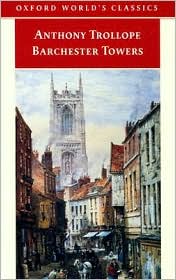
Barchester Towers


Trollope, Anthony. 1857. Barchester Towers. 528 pages.

In the latter days of July in the year 185--, a most important question was for ten days hourly asked in the cathedral city of Barchester, and answered every hour in various ways. Who was to be the new Bishop?

Barchester Towers is the second novel in Trollope's Barset series. The first in the series, The Warden, I reviewed several months ago. What characters carry over to the second one? Mr. Harding, the former warden, and his two daughters: Susan, married to Dr. Grantly, the archdeacon, the son of the very recently deceased Bishop, and Eleanor Bold, a (somewhat-recent) widow and the mother of young Johnny Bold.

Barchester Towers is about how complicated and convoluted relationships can become. It's not just about church politics. It's about social relationships as well. Though church politics does capture much of it. Who will be the new Bishop? Who will be the new warden of Hiram's Hospital? Who will be the new Dean?

The novel is a romantic comedy of sorts. Eleanor, a widow, is quite the catch and there are plenty of men in the neighborhood who would do almost anything to win her heart. But not all of them are worthy of it. And some of them are more interested in her money than in her. Her three suitors are Mr. Obadiah Slope (boo, hiss if you like, trust me he deserves it!), Mr. Bertie Stanhope, and Mr. Francis Arabin. Two of the three are church men. Mr. Slope is chaplain and in the employ of the new bishop, Mr. Proudie. And Mr. Arabin is the vicar of St. Ewold. Mr. Stanhope is a gambler mostly, an idle man who thinks only of living in the moment. Does Eleanor want to be courted? Is she looking for a second husband? A step-father for young Johnny? Whether or not this is the case, it can't be denied that the men in the neighborhood are looking at her.

I said Barchester Towers is a comedy, and that is very much the case. Comical characters abound in Barchester Towers! Mr. Slope. Dr. Proudie. Mrs. Proudie. Those three can get into so much trouble all on their own! I feel a bit sorry for Mr. and Mrs. Quiverful and their fourteen (living) children, a family that gets caught in this tug-of-war power play. Will he or won't he be named the new warden? And those are just a handful of the characters we meet in this second novel. There are the Stanhopes (including the married and attention-grabbing Madame Neroni), the Thornes, and the lower-class sort including the Lookalofts and the Greenacres. I believe Miss Thorne's party is the delight of the novel--spanning about eight chapters.

The order of the day was to be as follows. The quality, as the upper classes in rural districts are designated by the lower with so much true discrimination, were to eat a breakfast, and the non-quality were to eat a dinner. Two marquees had been erected for these two banquets: that for the quality on the esoteric or garden side of a certain deep ha-ha; and that for the non-quality on the exoteric or paddock side of the same. Both were of huge dimensions—that on the outer side was, one may say, on an egregious scale—but Mr. Plomacy declared that neither would be sufficient. To remedy this, an auxiliary banquet was prepared in the dining-room, and a subsidiary board was to be spread sub dio for the accommodation of the lower class of yokels on the Ullathorne property.

No one who has not had a hand in the preparation of such an affair can understand the manifold difficulties which Miss Thorne encountered in her project. Had she not been made throughout of the very finest whalebone, riveted with the best Yorkshire steel, she must have sunk under them. Had not Mr. Plomacy felt how much was justly expected from a man who at one time carried the destinies of Europe in his boot, he would have given way, and his mistress, so deserted, must have perished among her poles and canvas.

In the first place there was a dreadful line to be drawn. Who were to dispose themselves within the ha-ha, and who without? To this the unthinking will give an off-hand answer, as they will to every ponderous question. Oh, the bishop and such-like within the ha-ha, and Farmer Greenacre and such-like without. True, my unthinking friend, but who shall define these such-likes? It is in such definitions that the whole difficulty of society consists. To seat the bishop on an arm-chair on the lawn and place Farmer Greenacre at the end of a long table in the paddock is easy enough, but where will you put Mrs. Lookaloft, whose husband, though a tenant on the estate, hunts in a red coat, whose daughters go to a fashionable seminary in Barchester, who calls her farm-house Rosebank, and who has a pianoforte in her drawing-room? The Misses Lookaloft, as they call themselves, won't sit contented among the bumpkins. Mrs. Lookaloft won't squeeze her fine clothes on a bench and talk familiarly about cream and ducklings to good Mrs. Greenacre. And yet Mrs. Lookaloft is no fit companion and never has been the associate of the Thornes and the Grantlys. And if Mrs. Lookaloft be admitted within the sanctum of fashionable life, if she be allowed with her three daughters to leap the ha-ha, why not the wives and daughters of other families also? Mrs. Greenacre is at present well contented with the paddock, but she might cease to be so if she saw Mrs. Lookaloft on the lawn. And thus poor Miss Thorne had a hard time of it.

And how was she to divide her guests between the marquee and the parlour? She had a countess coming, an Honourable John and an Honourable George, and a whole bevy of Ladies Amelia, Rosina, Margaretta, &c; she had a leash of baronets with their baronnettes; and, as we all know, she had a bishop. If she put them on the lawn, no one would go into the parlour; if she put them into the parlour, no one would go into the tent. She thought of keeping the old people in the house and leaving the lawn to the lovers. She might as well have seated herself at once in a hornet's nest.
Anthony Trollope is fast-becoming one of my favorite authors. I am just falling in love with him. His style, his wit, his humor, his characterizations. The way he can talk about anything (and everything) and make me care. Even the bad guys. Trollope develops these scummy characters with such grace and charm that even though you know they're no good, you enjoy spending time with them.


© Becky Laney of Becky's Book Reviews

Jane Eyre - Charlotte Bronté


Orphaned Jane Eyre grows up in the home of her heartless aunt, where she endures loneliness and cruelty, and at a charity school with a harsh regime. This troubled childhood strengthens Jane's natural independence and spirit - which prove necessary when she finds a position as governess at Thornfield Hall. But when she finds love with her sardonic employer, Rochester, the discovery of his terrible secret forces her to make a choice. Should she stay with him and live with the consequences, or follow her convictions, even if it means leaving the man she loves? A novel of intense power and intrigue, Jane Eyre 1847) dazzled and shocked readers with its passionate depiction of a woman's search for equality and freedom.


Jane Eyre is my final book for the Victorian Challenge. I know I read this book in my teens but my memory was fuzzy at best and I must say that if not for the 2006 TV adaptation I probably wouldn't have been compelled to reread it.

It is interesting to read about Jane from childhood, she makes a compelling heroine even when she is a child. She is so focused and so serious in her views and descriptions that we can't help but to want to know more. I have to say though that the book really comes alive for me when Rochester enters the scene. I really enjoy reading about him and Jane matching wits. Jane is always described as a very plain heroine and while I understand that Charlotte Bronte wanted her to shine only through her intelligence and resourcefulness it was a bit too much to have most of the character referring to her like that, after all beauty is in the eye of the beholder.

The story is, of course, a wonderful Gothic, we feel Jane's pain and unhappiness though her childhood, even her relationship with Helen Burns ends in tragedy, and we know, because she says so, that she was never as happy as in Thornfield which she comes to consider her home. However there's always a powerful foreboding sense hanging over them that reaches its high point when Jane and Rochester are about to be married. It is no wonder that she runs away from him, if there's something that is with Jane from beginning to end it’s her strict moral code. While Rochester was a great brooding and mysterious hero there's no way she can accept what he wants and she runs away.

I felt the story slowed down a bit after that, or maybe it was that I wasn't that interested about St John Rivers. Although Jane is as morally irreprehensible as he is she is passionate about what she believes in and has a fire that the preachy St John never manages to achieve.

Bronte wrote a mysterious dark tale and I was quite happy to see things coming together for Jane in the end. Her reunion with Rochester promises her happiness at last. The book approaches many of the social problems of the time, through Jane Eyre's status and worries Charlotte Bronte shows that women had choices and could be independent but that it wasn't easy.

Grade: 4.5/5

Sunday, June 28, 2009

Little Dorrit by Charles Dickens

Little Dorrit
For years I loved Dickens' writing but I struggled to get through his books. Fortunately though, I have recently found a way to read that works for me. Short installments over a long period of time. Which makes sense when you remember that much of Dickens' work was originally published in serial form.
And so I made a resolution - to read one of the big books every year. And this year's big book is Little Dorrit.
At the heart of the book there is a simple story of two characters.
Amy Dorrit: The titular heroine. A young women, thinking the best of and doing her best for everyone, and resident with her father in the debtor's prison where she was born.
Arthur Clennam: A middle-aged man recently returned from working aboroad in his family business: He sees signs that his family is responsible for the troubles of the Dorrits and determines to uncover the truth.
Their stories are woven into a much bigger framework. Indeed Dickens presents a panoramic portrait of Victorian London. And through a wide range of characters he explores many of the problems of Victorian society. His primary target is the debtors prison. And then there are bureaucratic government bodies, greedy landlords. powerful bankers..... Themes that still resonate today.
The characterisation is superb, the settings are wonderfully evoked and there was not one moment I considered putting the book down until I reached the end of its 1070 pages.
Little Dorrit is not without problems. The plot sometimes gets a little lost when Dickens is hitting his targets and a few of the sub-plots and characters are not as strong as the others - maybe even a little superfluous.
But when it works it is superb, packed with incident and provoking an incredible mix of emotions.
And certainly it is a book that I am glad I made the effort to read, and one that I know will stay with me.

Thursday, June 25, 2009

The Woman in White by Wilkie Collins (audio)

The Woman in White is a very engaging Victorian mystery by Wilkie Collins. I listened to an audio version dramatized by Beverley Cooper and was hooked. I wanted to listen to it constantly to find out what happened. Good thing I was able to make it to my meeting today instead of sitting in the car trying to finish the book.

The novel starts with a bang when Walter Hartright is on his way to his new commission as an art teacher when he runs into a mysterious woman dressed from head to toe in white. He helps her to escape to London only to find out later that she had in fact just escaped from a lunatic asylum. Walter arrives at his new post at Limmeridge Hall and meets his new students, half-sisters Marian Halcombe and Laura Fairlie. Laura is a beautiful heiress. Walter and Laura soon fall in love. Unfortunately, Laura is betrothed to another, Sir Percival Glyde. She promised her father on his death bed that she would marry Sir Percival. With misgivings, Laura marries Sir Percival and soon finds out the truth about the mysterious woman in white. I will not say more on the plot except that it is a thrilling read!

I liked the format of the book. It gave the story from multiple sources and view points, which I read that Collins used because of his legal training. This novel is also one of the first detective stories as Walter Hartright tries to solve the mystery of the woman in white and of what happened to Laura Fairlie.

I also loved the forthright Marian Halcombe, the “ugly,” but sharp half-sister of Laura. She is a great character and I found her more interesting than Laura who was slightly one-dimensional. I also liked the feminist aspects of the novel – it really points out the flaws in the laws during Victorian times when it came to women inheriting an estate.

Another interesting note is that as a young man, Collins had his own run in with a mysterious woman in white, who later became his mistress. I read this in the forward to my novel and was intrigued.

Saturday, June 20, 2009

The Woman In White - Wilkie Collins


A mysterious figure in white appears on Hampstead Heath, before the
narration moves to a large North Country house. Sections of the storyline are taken up by a variety of characters, through whose eyes we experience events in this romantic, gothic thriller.
I had read The Woman in White in my teens and now I had only a vague idea of the plot so I decided to read it again.

Wilkie Collins writes an intriguing and engaging story. From the moment when Walter Hartright meets a mysterious woman in white running away from a private asylum and helps her, we are drawn into the puzzle of who she is. After Walter arrives at his next employment, it becomes apparent that there must be some relationship between the woman and Laura Fairlie, for whom Walter falls in love. And after Laura married the man her late father had destined to her and Walter leaves the country to forget her it seems apparent that Laura’s Husband and his friend Count Fosco are involved in a mystery of their own.

As soon as Laura marries Sir Percival Glyde and they return from their honeymoon to live with her sister Marian Halcombe it is apparent that Sir Percival’s main interest is his wife’s money and he will do all in his power to get it, dutifully aided by Fosco.

I think one of the main attractions is how the story is written. It is presented as a series of letters by some of the most prominent intervenients in the action so the point of view differs according to who is remembering the events. While it was sometimes frustrating to read how easy it was for the conspirators to fool everyone it was also an interesting exercise to read about everyone’s thoughts and how they had different voices.

I must say that I found Marian to be the most appealing character; she is strong, sensible and determined where Laura always seems too distant. While she and the woman in white are the key to the whole conspiracy she seems more like an object of adoration up in its pedestal than an active participant. Marian and the sinister Count Fosco are definitely the characters that I most vividly remembered after closing the book. Wilkie Collins is great at plotting and keeping us in suspense until the end when everything is revealed.

Grade: 4.5/5

  © Blogger template 'Minimalist E' by Ourblogtemplates.com 2008

Back to TOP